
Organizations across media, education, and enterprise review workflows ask the same underlying question: can we show what was submitted, that it has not changed since a defined checkpoint, and that an independent reviewer can verify those facts? AI-assisted writing raised the visibility of authorship debates, but integrity proof answers a different question than stylistic guessing - and it is the one general counsel and accreditation reviewers increasingly expect.
Where proof records fit first
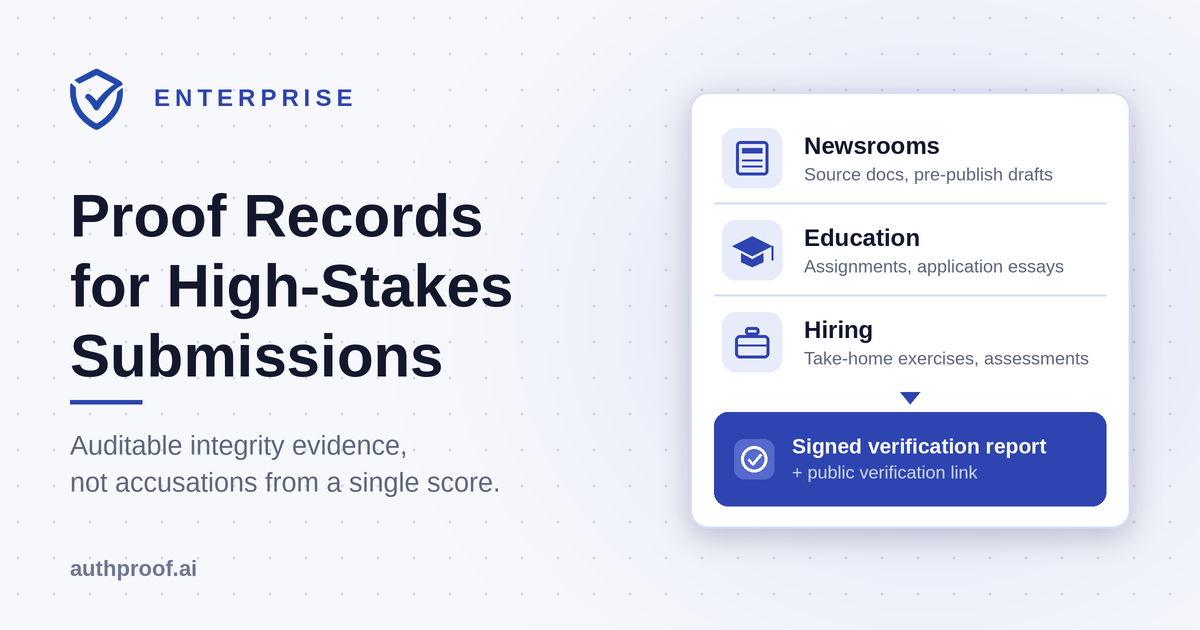
Newsrooms register source documents and pre-publish drafts when readers expect tamper-evident integrity. Schools and universities register assignments and academic submissions when review teams need defensible chains of custody. Enterprise teams register content assets when audit trails and chain-of-custody matter. AuthProof’s founding customer work prioritizes media and education precisely because those workflows combine high scrutiny with a clear need for shareable verification.
Policy beats accusation
Requiring submissions through a documented proof workflow - SHA-256 fingerprints, optional signatures, signed PDF reports - is a neutral, auditable policy. It reduces reliance on probabilistic AI scores that create false positives and compliance exposure. Submitters and contributors should know what is measured, what is not, and who reviews edge cases.
What to require from a platform
Export signed verification reports for retention. Publish public verification pages with explicit proof scope. Maintain chain-of-custody timelines reviewers can follow without vendor access. Treat writing-style signals as optional context on the same record - never as an silent auto-reject. AuthProof is built for that evidence-first model from proof record creation through link and embed publication.
Start one pilot, measure evidence time
Select a single intake channel, register proof for thirty days, and measure how long it takes a non-specialist to validate a submission using your public verification link. If that time drops and stakeholders trust the certificate language, expand to the next workflow. Enterprise trust is operational, not rhetorical.